

Calculating the strength of a steel structure member is a crucial aspect in the field of steel structure engineering. As a steel structure supplier, I understand the significance of accurate strength calculations for ensuring the safety and reliability of our products. In this blog, I will share some key methods and considerations for calculating the strength of steel structure members.
Understanding the Basics of Steel Structure Member Strength
Before delving into the calculation methods, it's essential to understand the basic concepts related to the strength of steel structure members. The strength of a steel structure member mainly refers to its ability to resist various loads, such as dead loads, live loads, wind loads, and seismic loads. There are several types of strength that we need to consider:

- Yield strength: This is the stress at which a material begins to deform plastically. For steel, it is a critical parameter as it indicates the onset of permanent deformation.
- Ultimate strength: It is the maximum stress that a material can withstand before failure. In steel structure design, we need to ensure that the member does not reach its ultimate strength under normal service conditions.
- Buckling strength: Buckling is a form of instability that can occur in slender members under compressive loads. The buckling strength determines the maximum compressive load a member can carry without buckling.
Calculation Methods for Different Types of Loads
Axial Loads
When a steel structure member is subjected to axial loads (either tension or compression), the calculation of its strength is relatively straightforward.
- Tensile strength: For a member under tension, the tensile strength can be calculated using the formula (P_t = A\times f_y), where (P_t) is the tensile capacity, (A) is the cross - sectional area of the member, and (f_y) is the yield strength of the steel.
- Compressive strength: In the case of compression, we need to consider the possibility of buckling. For short columns, the compressive strength can be calculated similar to the tensile strength, (P_c = A\times f_y). However, for long columns, we use the Euler's formula or more refined design codes. For example, according to the AISC (American Institute of Steel Construction) code, the compressive strength of a column is determined by considering the slenderness ratio ((L/r), where (L) is the effective length of the column and (r) is the radius of gyration).
Bending Loads
When a steel member is subjected to bending, we need to calculate its flexural strength. The most common approach is based on the concept of the plastic section modulus ((Z)). The flexural strength ((M_p)) of a member can be calculated using the formula (M_p = Z\times f_y). In addition, we also need to consider the shear strength in the web of the beam. The shear strength ((V)) can be calculated using the formula (V = 0.6\times f_y\times A_w), where (A_w) is the area of the web.
Combined Loads
In real - world situations, steel structure members are often subjected to combined loads, such as axial load and bending moment. To calculate the strength under combined loads, we use interaction equations. For example, the AISC code provides interaction equations for different combinations of axial and bending loads. One of the common interaction equations for a member under axial compression and bending is (\frac{P}{P_n}+\frac{8}{9}(\frac{M_x}{M_{nx}}+\frac{M_y}{M_{ny}})\leq1), where (P) is the applied axial load, (P_n) is the nominal axial strength, (M_x) and (M_y) are the applied bending moments about the (x) and (y) axes, and (M_{nx}) and (M_{ny}) are the nominal flexural strengths about the (x) and (y) axes.
Factors Affecting the Strength of Steel Structure Members
- Material properties: The quality and properties of the steel, such as its yield strength, ultimate strength, and ductility, have a significant impact on the member's strength. Different grades of steel have different mechanical properties, and we need to select the appropriate grade according to the design requirements.
- Cross - sectional shape: The shape of the cross - section also affects the strength. For example, I - beams are more efficient in resisting bending compared to rectangular sections. The distribution of material in the cross - section affects the section modulus and the radius of gyration, which are important parameters in strength calculations.
- Connection details: The connections between steel members can affect the overall strength of the structure. Poorly designed connections can lead to stress concentrations and reduced member strength. We need to ensure that the connections are designed to transfer the loads effectively.
Our Products and Their Strength Considerations
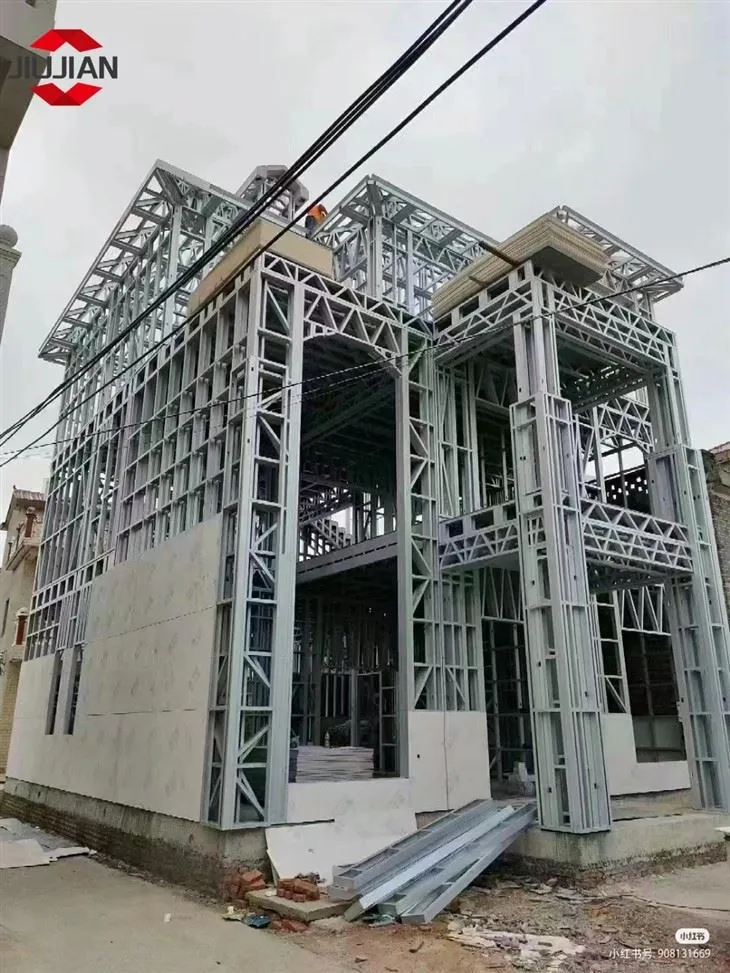
As a steel structure supplier, we offer a wide range of products, including Steel Structure Villa, Galvanised Steel K - type Prefabricated House, and Light Steel Villa House.
- Steel Structure Villa: In the design of steel structure villas, we carefully calculate the strength of each member to ensure that it can withstand the various loads, such as the weight of the roof, the live loads from occupants, and the wind loads. We use high - strength steel and optimize the cross - sectional shapes of the members to achieve a balance between strength and cost.
- Galvanised Steel K - type Prefabricated House: These prefabricated houses are designed to be lightweight yet strong. The galvanized coating on the steel not only provides corrosion resistance but also does not significantly affect the strength of the steel. We calculate the strength of the members considering the modular design and the connection details to ensure the overall stability of the house.
- Light Steel Villa House: Light steel villa houses are known for their fast construction and energy - efficiency. We calculate the strength of the light steel members to ensure that they can support the design loads. The slender members in these houses require careful consideration of buckling strength, and we use advanced design methods to ensure their safety.
Importance of Accurate Strength Calculations
Accurate strength calculations are essential for several reasons:
- Safety: Ensuring that the steel structure members can withstand the design loads is crucial for the safety of the occupants. A miscalculation of strength can lead to structural failure, which can have serious consequences.
- Cost - effectiveness: By accurately calculating the strength, we can optimize the design of the steel structure members. This means using the right amount of steel, avoiding over - design, and reducing the overall cost of the project.
- Compliance with standards: Most countries and regions have building codes and standards that specify the requirements for the strength of steel structure members. Accurate strength calculations are necessary to ensure compliance with these standards.
Contact Us for Your Steel Structure Needs
If you are interested in our steel structure products or need more information about the strength calculations of steel structure members, we invite you to contact us for procurement and further discussions. Our team of experts is ready to assist you in selecting the right products and ensuring that your steel structure project meets all the necessary strength and safety requirements. Whether you are planning a Steel Structure Villa, a Galvanised Steel K - type Prefabricated House, or a Light Steel Villa House, we have the solutions for you.
References
- American Institute of Steel Construction (AISC). "Specification for Structural Steel Buildings".
- Timoshenko, S. P., & Gere, J. M. "Theory of Elastic Stability".
- Blodgett, O. W. "Design of Welded Structures".